Showing posts with label Military Aircraft Crash Sites. Show all posts

Sunday, 25 November 2018

North American Mustang P-51 AP208
 North American Mustang Mk1 AP208 crashed here , on Holdren Moss in the Forest of Bowland on  29.11.1942. Crashed in mist twenty minutes into a photo  reconnaissance  sortie.
It was from No.4 Sqn, RAF, based at that time at Clifton.. This was the first Mustang lost by the squadron, two more were lost in training accidents before the year was out.
The pilot F/O Sholto Paton Marlatt (RCAF) was killed instantly. He is buried at Lytham St.Annes park cemetry.
Another bleak boggy moor , another pile of wreckage and another  young mans tragic death .
For such a small plane quite a lot is still there.


Sunday, 15 November 2015

De Havilland Vampire VZ874


DE HAVILLAND VAMPIRE VZ874

A 'VZ'  in rocks denotes the location the aircraft impacted the mountain
 On the 12th October 1956  at 1910 hours this aircraft , the De Havilland Vampire VZ874 took off from RAF Valley on nearby Anglesey.  The pilot, a member of the Fleet air Arm, Sub-Lt R. Davies was in training on Vampires and had just begun his night flying training having already flown a total of 110 hours in the type. His brief that night was to fly locally and do circuits (landings and takeoffs at the airfield).
Flying by instruments alone and only ten minutes after taking off the aircraft crashed into the West of the summit of Mynydd Mawr in Snowdonia. Unfortunately Sub-Lt Davies was killed in the crash.
The aircraft is said to have exploded on impact many parts of the aircraft continued across the summit and fell into the the cwm below  on the East face of the  summit.
The alleged impact point is now marked by the aircraft's letters in the scree a V and a Z .We found nothing here now...but possibly didnt look hard enough because photographs of small fragments can be seen on the internet.
On descending into Cwm Planwydd we had more success finding engine parts and aircraft spars.
The Aircraft a D.H. 100 F.B.Mk 5 was built at Broughton as a batch order of 63 machines.

A spar and some engine parts in the Cwm

Saturday, 16 August 2014

Avro Anson N9853


Avro Anson N9853


 On the 11th December  1944 , this aircraft flying from RAF Newton to RAF Millom and  piloted by Flt.Lt. Aleksander Chelstowski , crashed into the plateau on top of Kinder Scout in the Dark Peak . He was accompanied on the flight by his wireless operator a Flt Sgt Stefan Pasinski and 4 passengers . Happily all survived the crash on the snow covered top .


After a couple of clearances little remains apart from the two engines and a few panels .

I,ve visited the site on a couple  of occasions . Never in very clement weather though . Our last visit was in pouring rain ,our first in snow and low cloud .


Tuesday, 12 August 2014

Wellington W5719


Wellington W5719
View down the valley into Edale

Bomb fragment

On  the 31st July 1941 Wellington W5719 crashed into Kinder Scout in the Peak District . It was returning from a raid on Cologne ,Germany .
It is alleged that the bombs had not been dropped due to cloud cover over the target and that the aircraft was returning to RAF Snaith in Yorkshire .
That night there was also low cloud over Northern England and their location must have been misjudged because they flew beyond the airfield  and into the flank of Kinder Scout .
On impact the bombs exploded flinging the rear turret away from the aircraft and down into Grindsbrook Clough  . In the rear turret the very fortunate Rear Gunner Sgt Earl Tilley survived . The other crew members all died in the impact .
Bomb fragments
They were
Sgt Percival Harold Charles Parrott   Pilot
Sgt Joseph Arthur Haswell  Pilot
Sgt Jack Douglas Evelle  Nav
Sgt Frederick Kenneth Webber  WO/AG   
Sgt Dennis Aloysius Monk  AG

and of course the survivor Sgt Earl Tilley AG

Sgt Evelle was a Canadian .
The pictures below show the site just below the perimeter path . Little remains today , small fragments and  lumps of molten alloy . There is a small  cross and plaque dedicated to the men .   On a recent visit I realised that some of the debris left at the crash site was bomb casing fragments from exploded bombs . There are sources that say the aircraft had dropped its bombs . These fragments at the very least prove that they didnt drop all the bombs .

Sunday, 20 April 2014

Avro Lancaster NE132


Avro Lancaster NE132
Wreckage lays amongst the scree in the foreground 
Reduction gear still with stubs of the props attached

 On the 6th February 1945 flying out of RAF North Luffenham  , Lancaster NE132 crashed into the flank of Rhinog Fawr in North Wales whilst on a cross country training flight .
The aircraft apparently entered a Cumulo-Nimbus cloud,  ice formed upon the  fuselage and wings causing a catastrophic airframe failure . The aircraft broke up in flight plummeting down into the mountainside .


 Fatigue may have played its part for the aircraft had completed many missions over enemy territory before being 'retired' into No. 1653 HCU for use in training .


Engine parts


The whole crew of 7 men died.

F/O David H.R.Evans    Pilot
F/O Maxwell W. Moon  Navigator
Sgt. Charles W. Souden   Bomb Aimer
Sgt. George E.W. Hodge  Flt. Engineer
Sgt. Arthur D. Gash          Air Gunner
Sgt. Harold Neilsen          Air Gunner
Sgt. Alfred E. Oliff      Air Gunner/Wireless Op


F/O;s Evans and Moon were  Australian and members of the RAAF.
 Sgt Neilsen was from Chile .

It is known that two of the men managed to bale out but were too low for their parachutes to open properly .
The bodies of two other crewmen, F/O Evans and Sgt Gash  have never been found . This makes the main  impact point a war grave . Their names are on the Runnymede Memorial . F/O Evans on panel 283 and Sgt Gash on panel 272 .


Wednesday, 26 March 2014

Vickers Valiant WZ363


Vickers Valiant WZ363
Traces of what is supposed to be the remnants of the impact crater today
On the 6th May 1964  at 23.50 ,WZ363 crashed into farmland near Market Rasen in Lincolnshire .
flying out of RAF Marham on exercises they had just finished doing a practise PAN rolling landing at RAF Binbrook  and  had been cleared to turn in a southerly direction to return to Marham .
  It is thought that the tailplane actuator malfunctioned in some way , this though as never been  proven . The crash was so violent as to make an absolute  reason for the crash impossible to work out .  However the pilot was in contact with  Radar Approach Control at Brinbrook only moments before the crash  and seemed relaxed , so it must have been a sudden and quickly developing event .
All 5 crewmen were killed instantly .
 They were :

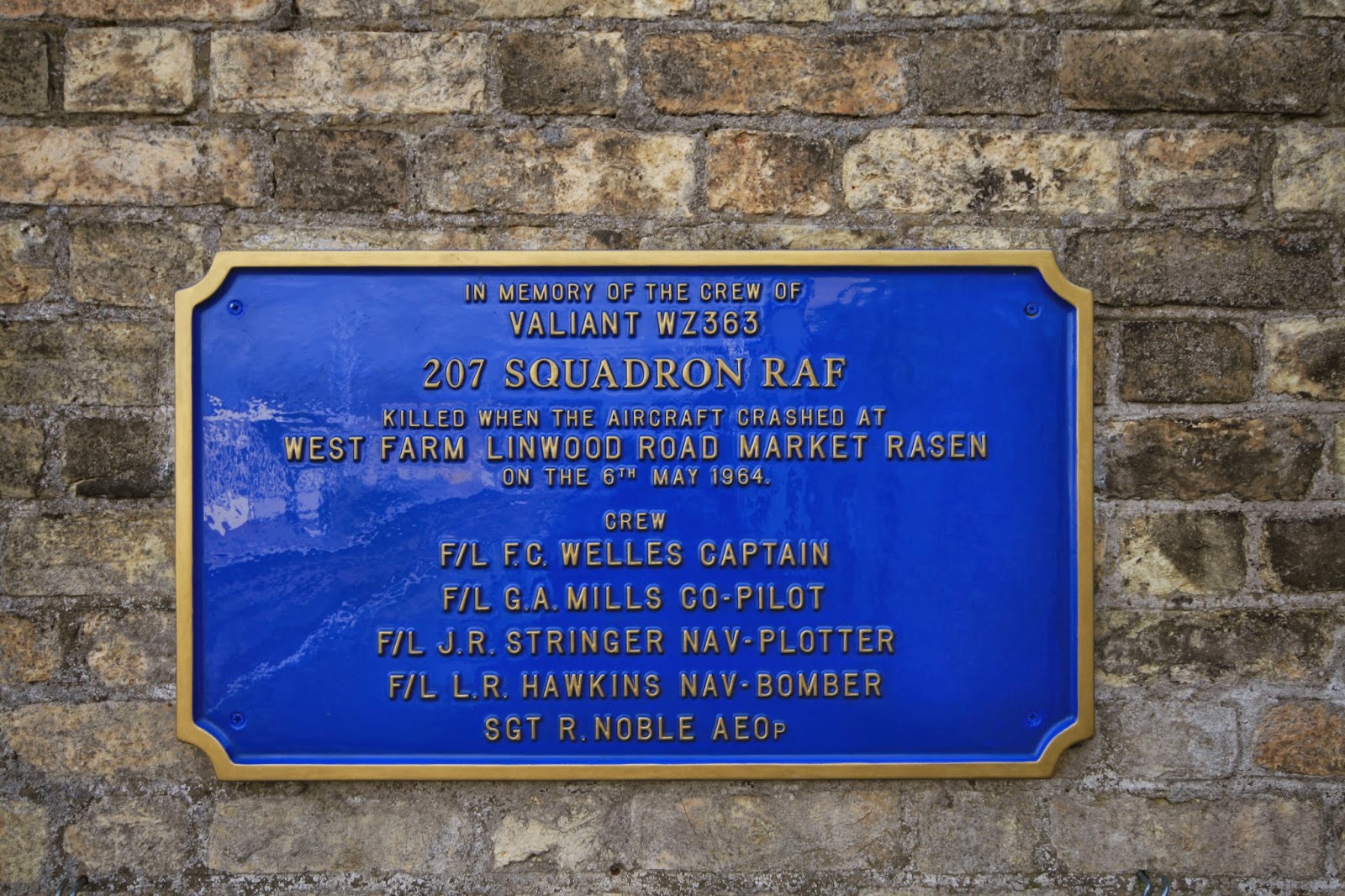
F/Lt  F.C. WELLES        Captain
F/Lt  G.A. MILLS           Co-Pilot
F/Lt  J.R. STRINGER     Navigation Plotter
F/Lt  L.R. HAWKINS      Navigation Bomber
Sgt R. NOBLE                 Air Electronics Operator

I have never visited the site myself . These shots were supplied by my friend and  keen aviation fan and historian Al who has kindly given me permission to use his shots .

There is a webpage on the 207  Squadron website worthy of note which covers the crash in very great detail , so much so that it leaves nothing new to be said . I include a link here, just copy and search .  http://www.207squadron.rafinfo.org.uk/valiants/welles_060564.htm


 At the local railway station a plaque and memorial has been raised in memory of the crew
Two more shots of the crash area

As a footnote .  The aircraft type flew its last missions (as tanker and another in a conventional role) on December 9th 1964 . The type was struck off in early 1965 . The change in tactics during the Cold War required Britains   nuclear V-force bombers to fly in at low level to avoid radar contact . The Valiant was not designed for this and its airframe could not stand the extra stresses involved . A glorious aircraft whose operational life was brought to a sharp end due to technological advances in other areas of warfare.
ASN as the crash record for Valiants as this

WB210                   12/1/52               1 fatal                    prototype
WP222                  29/7/55                4 fatal
WP202                  11/5/55                3 fatal                   
WZ398                  13/9/57               
XD869                   11/9/59                6 fatal                   at Marham              
XP864                    12/8/60                5 fatal
WP205                  17/11/60             
WZ399                  3/11/61               
WP200                  14/3/61
WZ363                  6/5/64                   5 fatal                    Rasen crash
WZ396                  23/5/64
Thanks Al for finding this out for me .

Saturday, 8 February 2014

Blackburn Botha L6202


Blackburn Botha L6202

The engine that never gets found ..... I stood on it but missed it ...good job one of us was looking !
Flying out of Hooton Park on a training flight on the 28th August 1943. L6202 crashed into the mountain Llwytmoor in Snowdonia ,Wales.
The weather was fine and clear except for the peaks of the Welsh mountains .
The weather though ,deteriorated after the crash which resulted in the search and rescue operation taking over 5 days to complete. The aircraft must have hit the mountain at high speed ,  the engines tumbling down the mountain from the impact point , a large gouge can still be seen in the rock made by the engine just prior to becoming wedged in this prominent position. The second engine made it all the way down the very steep slope  to the stream . 
The 4 crewmen were all killed .

Sgt. George M. Heppinstall     Pilot
Sgt. William Fearson               WO/AG
Sgt. Douglas Hargreaves       WO/AG
Sgt. Wendlin Bettin                   WO/AG

Sgt. Bettin was a member of the Royal Canadian Air Force .


The usual shot !

some of the wreckage that is strewn down the hillside


Thursday, 6 February 2014

Westland Lysander V9403


Westland Lysander V9403


On the 19 August 1941 this aircraft crashed into Featherbed Moss near Chew Reservoir in the Peak District.

The aircraft was intending to fly to Wales to provide gunnery and searchlight practise for the recruits at Gunnery and Torpedo training base on the Great Orme , click the link to see the base  news.bbc.co.uk/local/northwestwales/hi/people_and_places/... .

Flying out of Ringway (now better known Manchester Airport) it flew in completely the wrong direction due to the Gyro compass being either faulty or set wrongly. Cloud was down below 2000ft, the pilot realising something was amiss but believing himself to be over the low plains of Cheshire reduced heigtht in an attempt to get beneath the cloud . He never made it .
The Lysander had a crew of two . Both men survived the crash itself but were not found for a couple of days . They were trapped in the mangled wreckage , which ultimately proved fatal for the Wireless Operator who died in hospital 5 days later probaly due to the build up of toxins in his trapped body .
The crew were 

P/O Fredrick W. Hoddinott Pilot (survived)
LAC Allen M. Chadwick Wireless Op. Died in hospital on the 24th August 1941.

CWGC has Leading Aircraftman Chadwick , who was 22 years old , buried at Bebington in the Wirrel . 

The aircraft itself was built as a Mk.IIIA by Westland in Yeovil.
The crash site is  on a  featureless moor , very little remains and it can be difficult to find with a map and compass . I managed but probaly one for a GPS in truth .  
That said it makes part of a good wrecksite round along with a nimber of other aircraft in the area .

Monday, 3 February 2014

Handley Page Halifaxes LL178 & EB181


Handley Page Halifaxes LL178 and EB181

Kepwick Moor/Arden Great Moor  an area of the North Yorkshire Moors  with a number of Handley Page Halifax crashes within quite a close proximity . 
In the shot above can be seen a cross placed   to commemerate the loss of LL178 . 

Many experts have searched the area of the moor here and concluded that this is actually the crash site of EB181  . There is though no trace now on the surface . It is claimed that fragments of wreckage are combined at the real LL178 crash location . That may or may not be the case , whilst it is reletively close it is still far enough away to make it an imposition to move wreckge to that location . With a number of nearer old quarry workings closer by it would have made more sense to dump fragments in those .
 Anyway , This is a shot of a memorial to LL178 and is at the alleged  site of  the EB181 crash  .

In the distance can be seen the private woods of Arden Hall , another Halifax (JD174) carrying a bomb load crashed into those woods  . Aircraft crash enthusiasts are not welcome there due to some dubious behavior from over zealous wreckage collectors in the past . 
EB181 crashed in poor visibility from simply being not high enough , two crewmen initially survived the crash , one dying later from his injuries leaving a sole survivor .
The men who died were 


F/O Raymond H. Highsted     Pilot
Sgt John C. Mitchell       Navigator
Sgt Frederick J. Luckett    Bomb Aimer
F/Sgt John J. Timmins    Flt Engineer
Sgt James Nelson    Air Gunner
Sgt Herbert P. Durtnall Charlton    Air Gunner (died later of his injuries, 9.10.43) .

The man who survived 
 Sgt Charles F. West    Wirless Operator / Air Gunner


They were flying on a cross country exercise from RAF Croft . the aircraft hit the hill on the return leg to the airfield just after midnight at the start of a new day 28th September 1943.
The aircraft did not burn and must have remained largely intact or surely there would have been more fragments still in location on the moor .

Conversely , evidence of LL178's crash site is very obvious  .

Contents of a pit of collected wreckage


On the 18th March 1944 this aircraft flew on a 'Gardening' mission  over the North Sea towards the  archipelago of Heligoland .  On its return to RAF Croft the aircraft descended into the hill. They were literally moments from clearing the hill and would have been home and safe .That was not to be though , the impact was with great force evidenced by smashed castings and wrinkled panels still at the site today . 
The impact was also followed by a fire which must have destroyed much of the aircraft wreckage . 
All on board LL178 died . All of the crew were of the RCAF.
They were 

 
F/O David C. Evans Pilot
P/O Douglas A. Thicke 2nd Pilot

P/O Geoffrey Hutt Flt.Engineer
F/O Edson G. Armour Navigator
P/O Donald E Jackson Bomb Aimer
Sgt. Walter Cotton Wireless Op. / Air Gunner

P/O .Joseph S. Sleigher Air Gunner

P/O Robert E. Ballentine  Air Gunner


Pilot Officer Thicke was working upto his own aircraft and was on his second dicky flight . Had he survived he would probaly have been flying his own aircraft and crew on missions , perhaps even the following night . 
Gardening was the coloquelism refering to laying mines in the  German sealanes,   gardening because the RAF used vegetables as codewords for  sea areas !


Two areas of burnt ground containing wreckage can be seen at the LL178 crash site . 
In the picture to the left Al and Ian can be seen in the distance stood in the larger of the two areas .
A number of pieces of wreckage contain part numbers . 
and at least one has a manufacterers mark . 
The fuselage of the aircraft must have burnt in the larger burn area because on the surface can be seen many exploded bullet casings . Most .303 bullets of the era carry a date stamp on the base ....the ones I  looked at here were either dated 1942 , 1943 , 42 , 43 or   even a couple not dated at all ! Something I had not seen at a crash site before, no date on a bullet  . 
 A 1944 dated bullet would have confirmed that it came from LL178 not EB181 of course . 
There was no more luck with the Makers mark .... R2 , seen below faintly within a partial circle  on the left of shot  led me to a dead end as well .
  R2 refers to Rootes Motors (later Rootes Securities ) who built 1070 of the 6100+ Halifaxes built ......unfortunately EB181 was also built by the same company in an earlier batch of a hundred Halifaxes . LL178 itself  was built in a batch of 480 (not all mk V's) .
The B43 ....the B means its a part of the wing or flaps , the number is the part number itself,  odd (and 43 is odd) means port , so this is part of the port wing . 
The 57 prefix on the part number refers to this being a part for an  Halifax .  Handley Page coded their aircraft with H.P. followed by a number . The first Halifax post development was coded H.P. 57 , LL178 was a Mk.V , they were coded H.P.63 but the parts were largely  the same and thus they continued to be prefixed with a 57.  This is my understanding of how it worked ...if someone can make this complexity clearer to me please do so .
bullet casing dated 43

Ian and Al discussing the site


Some form of radio? still remains in fragmentary  condition at the site 

The stone plaque memorial made and placed by David Morris at the true location of the crash site . 

This site is a very interesting one and perhaps has some of the most comprehensive accounts available on the internet .   

The two stand out offerings are from Richard Allonby   http://www.yorkshire-aircraft.co.uk/aircraft/planes/44/ll178.htm
and http://rcaf434squadron.squarespace.com/51-60/ where a mass of information can be found including pictures of the crew and P/O Evans  logbook . 
There is enough there to write a book about the crews experiences   , perhaps one of them should do so .

My own take is more of a  swift resume and hopefully will cover the main points along with a few musings from myself.

Saturday, 1 February 2014

Bristol Beaufighter RD210


Bristol Beaufighter RD210

looking up the mountain toward the gulley which contains much wreckage

On the 10th of February 1945 this aircraft flying out of RAF Pershore to test fuel consumption rates crashed into the rockface of Aran Fawddwy  presumably  they had become  lost  whilst flying through some  bad weather .  They were part of No1 Ferry Unit .

The two man crew  were killed . 
They were 

F/O Alan L. Roe    Pilot   RAAF

W/O  Derrick R. Newbury      Nav     RAF

The gulley is very steep and has a 'bad step' not far down . We descended in fairly deep snow which made the going easier at least at the top . luckily it had recently avalanched and seemed as safe as something like this can be , with broken snow till it became to thin to matter . 
The bad step was a pig and covered in ice if youre gonna go down be sure of your abilities !  Its probaly easier to go up in summer!  
It was though great fun ....less fun was climbing back up and over the mountain to get back to the car ...a basic error of thought ....Aran Fawddwy is a big mountain and we did it twice the hard way !

This is the highest bit of wreckage we found , its quite large , there is probaly more higher but the snow cover prevented us from seeing it . 
That is my ice axe giving a bit of scale .


Looking down hill at the foot of the gulley , a peice of undercarriage is eveident in the foreground . Ian can be seen looking back up giving scale to the scene . The snow is definately thinning out here .
A small section of panel
Ian looking at a chunk and looking like he has enjoyed the scramble down the gulley
there are largish chunks all the way down to the water . Although we never did find one of the engines that was reportedly at the waters edge .
Ian at the top of the gulley close to the summit , the snow on the rocks doesnt look that deep but it was over knee high in more sheltered places and on the North side of the mountain it was a punishing climb to the top despite being a more gentle gradient
Thats me , rolling down the gulley , nimble like a fox ! It looks sunny but it was just a brief respite from the snow showers that came and went all day . Its amazing where this hobby can take you .